



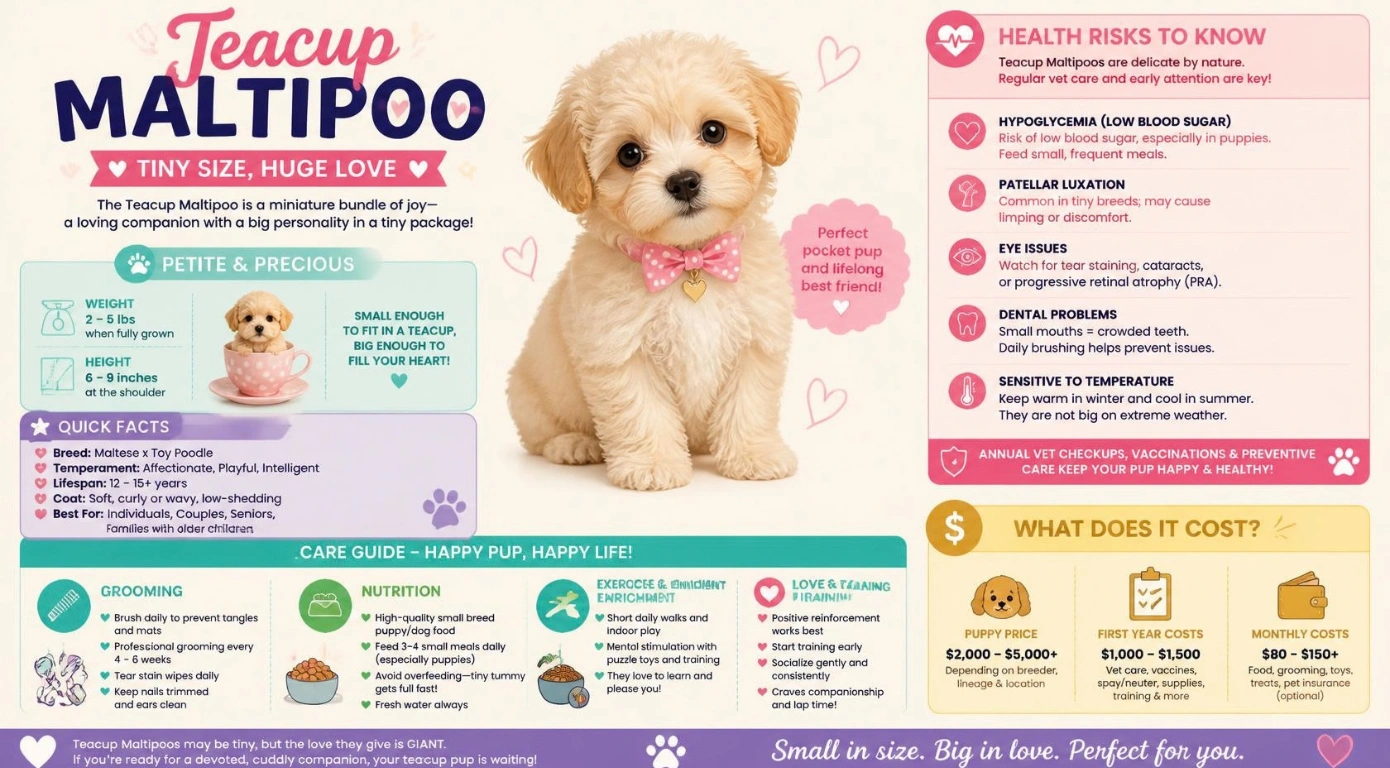
A teacup Maltipoo is an extra-small Maltese-Poodle mix sold under an unofficial size label. These dogs may look ideal for apartments, but their tiny bodies can require careful handling. US buyers should prioritize health testing and stable parent dogs over promises about extreme adult weight.
“Teacup” is not an official breed or AKC size category. Sellers usually use it for Maltese-Poodle mixes expected to stay unusually small, often near five pounds or less. Their size can increase everyday fragility, so buyers should compare parent health, veterinary records, and breeder practices before paying a premium.
| Question | Practical answer |
|---|---|
| What does “teacup” mean? | An informal marketing label for an unusually small dog. |
| Common advertised adult size | Often about 2–6 pounds, though no official standard exists. |
| Parent breeds | Maltese plus Toy Poodle, or another small Poodle line. |
| Typical temperament | Affectionate, social, alert, and responsive to positive training. |
| Main care concerns | Fragility, dental care, low blood sugar risk, grooming, and safe handling. |
| US purchase price | Often several thousand dollars, with large breeder-to-breeder variation. |
| Best home fit | Calm homes that can closely supervise handling and daily care. |
Key takeaways for US owners
- The label describes size marketing, not a recognized breed category.
- Adult size cannot be guaranteed from a puppy listing alone.
- Extreme smallness can make injuries and some medical problems harder to manage.
- Breeder transparency matters more than color, size claims, or premium pricing.
- Regular grooming, dental care, training, and veterinary care remain essential.
What does “teacup” mean?

The Teacup Maltipoo term describes an unusually small dog, not a standardized type. The American Kennel Club does not recognize “teacup” as a size designation for recognized breeds. That matters because a seller can use the Teacup Maltipoo label without meeting a universal weight rule.
The parent standards show why the label deserves caution. AKC guidance prefers Maltese dogs between four and six pounds, while Toy Poodles stand ten inches or less. Breeding below already-small parent sizes may increase fragility without creating a separate recognized breed.
How big does a teacup Maltipoo get?
Many current guides describe adults as around two to six pounds, but those numbers aren’t guaranteed. Parent size, genetics, nutrition, and general health all affect growth. Ask for both parents’ measured weights rather than relying on a seller’s projected number.
PetMD lists standard adult Maltese-Poodle crosses at about eight to fourteen inches and five to twenty pounds. Dogs marketed as teacup are smaller than that broader range by design. An unusually tiny puppy may still finish larger than the seller predicts.
| Size label | What it usually signals | Reliability |
|---|---|---|
| Teacup | Extra-small puppy or adult, often under six pounds | Informal and inconsistent |
| Toy-type | Small dog influenced by a Toy Poodle parent | More useful when parent sizes are verified |
| Mini-type | Larger cross influenced by a Miniature Poodle parent | Still variable because the dog is a mix |
Health risks in extremely small dogs
Small size does not guarantee poor health, but extreme miniaturization can create added concerns. PetMD lists hypoglycemia, dental crowding, collapsing trachea, orthopedic problems, and fragility among teacup-dog risks. Tiny puppies can also become sick faster because they have fewer energy reserves.
Daily safety matters as much as scheduled veterinary care. A short fall from furniture can be more serious for a very small dog. Rough play with larger pets or young children can also cause accidental injuries.
- Watch for weakness, shaking, confusion, collapse, or poor appetite in a tiny puppy.
- Use ramps or block access to high furniture when jumping creates a fall risk.
- Keep meals and feeding instructions consistent with your veterinarian’s advice.
- Use a well-fitted harness and supervise interactions with much larger animals.
- Start dental care early because small mouths are prone to crowding.
Get medical advice from your veterinarian, especially for a puppy under five pounds. Feeding frequency and medication doses can differ from those used for larger dogs. Never copy another owner’s treatment plan without professional guidance.
Temperament, training, and apartment life
The broader Maltipoo population is known for affectionate, social behavior and strong attachment to people. PetMD also describes these dogs as intelligent and responsive to positive reinforcement. Their small size suits apartments, but they may need training to manage barking and separation distress.
Use short training sessions with praise, toys, and small rewards. Consistent routines help sensitive companion dogs understand what happens next. For more training context, see Milsblog’s guide to stubborn dog breeds because training style should match individual behavior.
Grooming, exercise, and everyday care
The coat is often low-shedding, but low shedding does not mean low maintenance. Curly or wavy hair can mat without regular brushing and professional trimming. PetMD recommends routine grooming because coat care helps keep skin and hair healthy.
Exercise needs are modest compared with larger athletic breeds. Several short walks, indoor games, and training sessions can provide useful activity. Avoid pushing a fragile dog through long workouts that exceed its comfort or conditioning.
Pet-proofing should include plants, stairs, furniture, and small objects that can be swallowed. Milsblog’s carnation safety guide shows how common household items can create pet risks. The Milsblog Pets section also collects broader pet-care articles for owners building safer routines.
What does ownership cost in the United States?
Pricing varies by breeder, location, parent lines, and claimed adult size. PetMD reports about $1,000 to $4,000 for a Maltipoo puppy from a reputable breeder. Current teacup-focused guides often advertise higher prices, but a premium does not prove better health. Elsewhere on the site: Cat Attract Litter.
Budget beyond the purchase price because recurring care can add up quickly. Grooming, dental care, preventive veterinary visits, food, training, supplies, and emergencies all matter. Pet insurance may be worth comparing before a small puppy develops a documented condition.
| Cost area | What to plan for |
|---|---|
| Purchase | Puppy price, travel, deposits, and initial supplies |
| Veterinary care | Exams, vaccines, parasite prevention, testing, and illness care |
| Grooming | Brushes, combs, shampoo, trims, and professional appointments |
| Dental care | Home brushing supplies and veterinary dental treatment when needed |
| Safety setup | Harnesses, gates, ramps, crate, pen, and secure bedding |
How to evaluate a breeder before buying
A responsible seller should welcome questions about health, parents, and living conditions. AKC breeder guidance warns buyers to be cautious when “teacup” marketing prioritizes unusual size over health. You should be able to verify records rather than accept screenshots or vague promises.
- Ask for breed-appropriate health screening results for both parents.
- Request the puppy’s veterinary records and vaccination history.
- Meet the puppy and mother in person, or use a live video call.
- Confirm the puppy’s age, current weight, and expected pickup date.
- Read the sales contract and health guarantee before paying a deposit.
- Avoid sellers who promise an exact adult weight or pressure you to pay immediately.
- Be cautious with payment methods that offer little buyer protection.
Responsible placement also includes honest discussion about your household. A tiny dog may be a poor match for rough play, frequent unsupervised stairs, or much larger pets. A breeder who asks detailed questions is often trying to reduce preventable problems after placement.
Is this tiny companion a good fit for your home?
These dogs can suit calm adults, seniors, and careful households that want a close companion. They need time for grooming, social contact, training, and routine veterinary care. Families with young children should plan for close supervision because accidental drops and rough handling can cause injuries.
If your main goal is a small companion, consider health and temperament before size. A slightly larger toy-sized dog may be easier to handle and less physically delicate. The safest choice is the dog whose health, behavior, and care needs fit your household.
Next step
Start by comparing health records and parent information, not puppy photos or size labels. Schedule a pre-purchase conversation with a veterinarian if you are considering an unusually tiny puppy. Then choose a dog whose needs, temperament, and expected size fit your home for the long term.
Before paying a deposit, save copies of the contract and health records. Confirm the breeder’s contact details and schedule your puppy’s first vet visit. Those steps protect both your budget and the dog’s transition home.
Frequently asked questions
Is a teacup Maltipoo hypoallergenic?
No dog is completely hypoallergenic, even when shedding is limited. PetMD notes that Maltese-Poodle crosses can still release allergens through dander and saliva. Spend time with the individual dog before adopting if someone in your home has allergies.
How long do these dogs live?
There is no official lifespan standard for the teacup label. PetMD gives the broader mix a typical lifespan of about twelve to sixteen years. Breeding quality, dental care, weight, injury prevention, and regular veterinary care can influence longevity.
When is a tiny puppy full grown?
Small companion dogs usually reach most of their adult size during the first year. Exact timing varies with genetics, parent size, nutrition, and health. Your veterinarian can track growth using repeated weights and body-condition checks.
Are these dogs good with children?
Many are affectionate, but body size creates a separate safety issue. Young children may accidentally drop, squeeze, or step on an extremely small dog. Close adult supervision and gentle handling rules are essential.
What should I ask before sending a deposit?
Ask for parent health records, veterinary paperwork, current weight, age, and a written contract. Verify the breeder’s identity and use a payment method with appropriate protections. Walk away from pressure, secrecy, or guarantees that sound impossible.
