




Appellate jurisdiction is a court’s legal power to review decisions made by a lower court or tribunal. In the United States, that power depends on constitutions, statutes, court rules, and the order entered. An appeal cannot proceed merely because one party disagrees with the result.
Quick answer: Appellate courts review alleged legal or procedural errors instead of retrying a case from the beginning. They usually review final judgments, although certain nonfinal orders can be appealed earlier under specific rules. Their authority comes from governing law, so parties must identify a valid route to appellate review.
| Key point | General U.S. rule |
|---|---|
| Main function | Review lower-court decisions for legal or procedural error |
| Federal trial appeals | Usually go from U.S. district courts to U.S. courts of appeals |
| Final judgment rule | Most federal appeals wait until the trial court enters a final decision |
| Interlocutory appeals | Some nonfinal orders qualify for immediate review |
| New evidence | Appellate courts generally review the existing record |
| Possible results | Affirm, reverse, vacate, modify, dismiss, or remand |
| Supreme Court review | Mostly discretionary through petitions for certiorari |
Key Takeaways
- Appeals review lower-court rulings rather than restart the case.
- Federal appeals usually require a final decision.
- Some nonfinal orders qualify for early review.
- Review standards depend on the issue presented.
- State appellate rules can differ from federal rules.
Appellate Jurisdiction and the Role of an Appellate Court
This authority determines whether a reviewing court may hear a particular appeal. That question comes before the court reaches the merits of the claimed error. If authority is missing, the court may dismiss without deciding who was right below.
The federal system illustrates the structure clearly. U.S. district courts generally act as trial courts, while regional courts of appeals review many district-court decisions. Federal appellate judges generally review briefs, the record, and applicable law.
Some cases also receive oral argument before a three-judge panel. The reviewing court focuses on claimed errors rather than hearing witnesses again. It normally does not receive a new trial record. U.S. Courts overview of courts of appeals
Original Authority Versus Appellate Review
Original authority concerns cases filed in a court at the beginning. Appellate authority concerns review of a decision already made elsewhere. The distinction explains why the same court can have different powers in different cases.
Article III gives the U.S. Supreme Court original authority in a limited category of disputes. It also gives the Court appellate authority in other covered cases, subject to congressional regulation. Most Supreme Court matters arrive after another court has already entered a judgment.
Federal district courts usually receive civil or criminal cases in the first instance. Reviewing courts generally examine what happened below under established standards of review. Understanding that difference explains why an appeal is not a new trial.
Which Decisions Can Be Appealed in Federal Court?
The central federal rule is that courts of appeals generally review final decisions of district courts. Congress states that rule in 28 U.S.C. § 1291. A final decision normally ends the litigation and leaves little beyond enforcement of the judgment.
This final-judgment rule reduces fragmented appeals during an active case. It lets trial proceedings develop a complete record before appellate review begins. Courts can often review earlier trial rulings after final judgment.
The rule also reduces delay from repeated appeals over routine trial decisions. A party usually cannot appeal every discovery ruling or denied motion immediately. Timing therefore becomes a threshold question before the substance of an appeal matters.
When Can a Nonfinal Order Be Appealed?
Federal law recognizes several exceptions for orders that may justify immediate review. Section 1292 covers certain interlocutory orders, including specified injunction decisions. It also creates a certification route for qualifying controlling legal questions. 28 U.S.C. § 1292
Federal Rule of Civil Procedure 54(b) can matter in cases involving multiple claims or parties. A district court may direct final judgment on fewer than all claims when the rule’s requirements are met. That action can create an immediate appeal route for the resolved portion.
The collateral-order doctrine is another narrow exception to ordinary finality. It applies only to a small category of important decisions meeting strict conditions. Parties should not assume that every urgent or costly ruling qualifies.
How an Appeal Reaches the Reviewing Court
An appeal normally begins with a timely notice filed under the governing procedural rules. The notice identifies the appealing party, the judgment or appealable order, and the reviewing court. Missing a controlling deadline can end the appeal before merits briefing begins.
After the record is prepared, the parties submit written briefs explaining the claimed errors. The appellant argues why the lower court should reverse or change its decision. The appellee responds and usually asks the reviewing court to preserve the decision.
Some appeals receive oral argument, while others are decided from the written record. The judges then issue a decision explaining the result or entering an appropriate judgment. Court-specific rules control briefing, timing, and other procedural details.
Readers researching related U.S. legal topics can also browse Milsblog’s law section. That section collects legal explainers written for a general audience. It provides useful background before reading more specialized court materials.
What Standards Do Appellate Courts Use?
The standard of review depends on the type of issue presented. Legal questions often receive de novo review, which gives no deference to the legal conclusion. Factual findings usually receive more deferential review under governing rules.
Discretionary trial decisions receive another level of review. A reviewing court may ask whether the trial judge abused the discretion allowed by law. The standard can strongly affect how difficult reversal becomes.
These standards show why appeals are not second chances to argue the same case. The reviewing court asks a narrower question about error under the applicable standard. A strong appeal must identify both the error and the proper review framework.
What Can an Appellate Court Do After Review?
A reviewing court can affirm the decision below when it finds no reversible error. It can reverse or vacate when the legal result cannot stand. It can also remand the matter for further proceedings under its instructions.
A remand does not always mean one party has completely won. The lower court may need another hearing or a corrected legal analysis. Some cases return to the reviewing court after later proceedings.
The precise remedy depends on the issue, governing law, and procedural posture. That flexibility is why appellate opinions often focus on requested relief. The court must have authority to grant the remedy sought.
Federal and State Appeals Do Not Follow One Identical Path
Each state has its own court structure, appellate statutes, deadlines, and procedural rules. Many states use trial courts, intermediate reviewing courts, and a court of last resort. Names and routes vary enough that federal assumptions should not carry over to a state case.
State law can also control which orders are immediately appealable. Those differences resemble other state-specific legal topics, including family and contract rules. Milsblog’s prenuptial agreement attorney guide shows why state-specific rules can change legal outcomes.
Federal courts also do not act as general reviewing courts over state judgments. The U.S. Supreme Court can review qualifying final state decisions involving federal issues. Lower federal courts generally cannot serve as ordinary appeal courts for state judgments.
Why Appellate Authority Matters Before the Merits
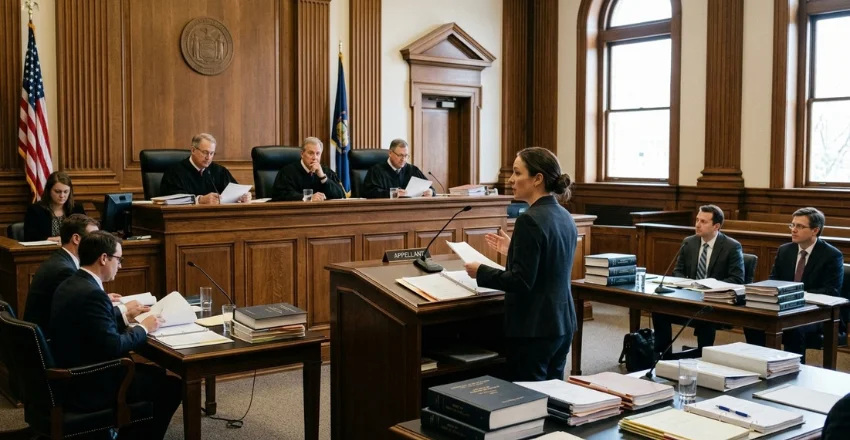
Appellate authority determines whether a court may hear an appeal. Parties cannot create that power by agreement, convenience, or consent. A strong merits argument cannot cure the absence of a lawful basis for review.
This issue can arise in civil and criminal cases. A criminal defendant may challenge a preserved legal ruling after a final judgment. Available issues depend on the governing law, the record, and any waiver rules.
Criminal appeals can involve pleas, sentencing, suppression rulings, and constitutional claims. Milsblog’s traffic stop rights guide explains constitutional issues that may later become litigation topics. Its nolo contendere guide also explains no-contest pleas.
Common Mistakes About Appeals
People sometimes assume they can appeal every unfavorable order immediately. That assumption conflicts with the final-judgment rule and its limited exceptions. The correct question is whether a statute, rule, or doctrine authorizes review now.
Another mistake is treating an appeal like a new trial. Reviewing courts normally work from the record already created below. New witnesses and new evidence usually do not enter ordinary appellate review.
A third mistake is ignoring filing deadlines while researching the merits. Procedural deadlines can be strict and may affect the court’s power to proceed. Anyone facing a real deadline should consult the applicable rules promptly.
Frequently Asked Questions About Appeals
What does appellate jurisdiction mean?
It means a court has legal authority to review a decision made by another court or tribunal. The reviewing court examines claimed errors under the rules governing that appeal. It may affirm, reverse, vacate, modify, dismiss, or remand as permitted.
Do appellate courts hear new evidence?
Usually, they do not hear a case again from the beginning. They generally review the existing record, written briefs, and applicable law. Limited exceptions may exist under particular rules or proceedings.
Can every court order be appealed immediately?
No, most federal appeals generally wait for a final decision. Specific statutes and doctrines allow immediate review of some nonfinal orders. The exact route depends on the order and governing procedural law.
Can the U.S. Supreme Court review state-court decisions?
Yes, the Supreme Court can review qualifying final state-court decisions presenting federal issues. Review is generally discretionary through a petition for certiorari. State courts ordinarily decide pure questions of state law.
What happens if a reviewing court lacks authority to hear the case?
The court can dismiss the appeal without reaching the claimed legal errors. That result can follow from a nonappealable order or another threshold defect. Parties therefore examine appealability before investing heavily in merits briefing.
The Practical Takeaway
Appeals begin with authority, not disagreement about the result below. The first task is identifying an appealable decision, the correct court, and the filing deadline. Only then does the merits analysis become useful.
For general education, start with the governing statute, court rules, and official appellate guidance. For an active case, deadlines and state-specific procedures deserve immediate attention. A licensed appellate attorney can assess those issues against the actual record and controlling law.
