



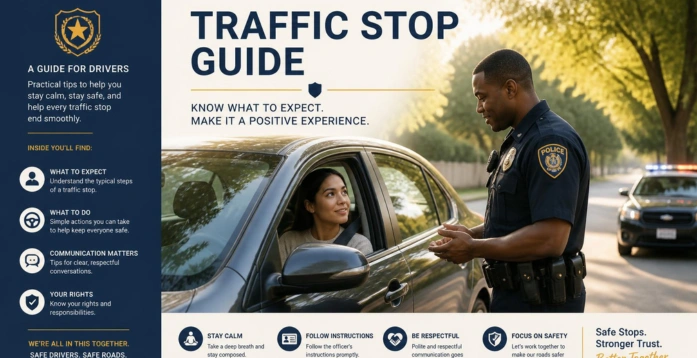
Seeing flashing police lights in your rearview mirror can make even an experienced driver nervous. A traffic stop is one of the most common ways motorists interact with law enforcement in the United States, yet many drivers are unsure what they must do, what they can decline, and where police authority ends. Understanding those basics can help you handle the encounter calmly while preserving your legal rights.
Quick answer: A traffic stop is a temporary roadside detention in which police investigate a suspected traffic violation or related offense. In the United States, it is a Fourth Amendment seizure. Drivers generally must stop, provide required driving documents, and follow lawful safety orders, but they retain important rights involving silence and searches.
What Is a Traffic Stop?
The encounter happens when a law-enforcement officer directs a driver to pull over and temporarily detains the vehicle while investigating a suspected violation or other lawful basis for the stop. For constitutional purposes, the U.S. Supreme Court treats the detention as a Fourth Amendment seizure. Passengers are also considered seized during the stop, which means they can sometimes challenge whether the stop itself was constitutional.
The encounter may begin because of speeding, an equipment problem, an unsafe maneuver, an expired registration, or another suspected traffic offense. A stop may also arise from circumstances giving an officer reasonable suspicion of other unlawful activity. The key point is that an officer generally needs an objective legal basis, not a purely unsupported hunch.
What Gives Police the Legal Right to Pull You Over?
Police do not always need enough evidence to prove a violation before making an investigative traffic stop. Under Supreme Court precedent, reasonable suspicion can support a brief vehicle stop when an officer has a particularized, objective basis for suspecting wrongdoing, and probable cause that a traffic violation occurred is also sufficient. The required justification depends on the circumstances and the nature of the suspected offense.
The officer’s hidden motivation normally does not invalidate an otherwise lawful stop based on an observed traffic violation. In Whren v. United States, the Supreme Court held that a stop supported by probable cause does not become unconstitutional merely because officers may have had another investigative objective. That rule is one reason apparently minor violations can sometimes lead to broader police questioning.
A stop can even survive certain reasonable mistakes about the law. In Heien v. North Carolina, the Supreme Court held that an objectively reasonable mistake concerning an ambiguous traffic law could still provide reasonable suspicion. That does not give police unlimited freedom to misunderstand traffic codes, because the mistake itself must be objectively reasonable.
What Should You Do When Police Signal You to Stop?
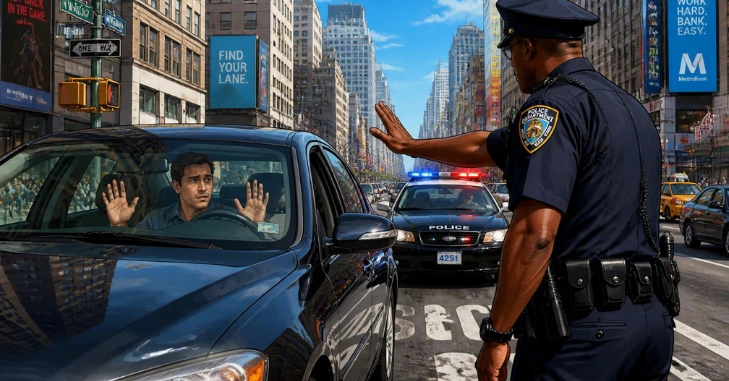
Signal your intention to pull over and move to a reasonably safe location as soon as you can do so without creating another hazard. Once stopped, turn off the vehicle, remain inside unless instructed otherwise, and keep your hands where the officer can see them. At night, turning on the interior light can also make your movements easier for the officer to see.
Avoid suddenly reaching into a glove compartment, center console, bag, or pocket before the officer knows what you are doing. If your registration or insurance card is stored somewhere you need to reach, tell the officer where it is before retrieving it. Staying calm is a practical safety measure, but it does not mean surrendering your constitutional rights.
| During the stop | General U.S. rule |
| Pull over | Stop in a reasonably safe location when directed |
| Driver’s license | Generally must be produced when lawfully requested |
| Registration | Generally must be produced when requested |
| Proof of insurance | Generally must be produced when required |
| Questions about your destination or activities | You generally have a right to remain silent |
| Request to search the vehicle | You generally may refuse consent |
| Order to exit the vehicle | Drivers, and generally passengers, may be ordered out during a lawful stop |
| Pat-down for weapons | Requires reasonable suspicion that the person is armed and dangerous |
| Leaving the scene | Do not leave until the stop has ended or an officer confirms you are free to go |
The table describes broad constitutional principles rather than every state-specific traffic rule. Identification laws, insurance-document requirements, firearm-disclosure duties, DUI procedures, and other obligations can differ depending on where the stop occurs. Widespread driving beliefs do not always match the statute books either, asMilsblog’ss guide to whether driving barefoot is illegal explains. When a state rule imposes additional lawful requirements, that local rule may affect what a driver must do.
Do You Have to Answer Police Questions?
Drivers generally have the right to remain silent beyond providing documents and information that applicable law requires. The Fifth Amendment provides that no person shall be compelled in any criminal case to be a witness against himself, which is the constitutional basis for that protection. You ordinarily do not have to explain where you came from, where you are going, what you were doing earlier, or why you believe the officer stopped you. Civil-liberties groups such as the ACLU advise people who want to invoke that right to say so clearly rather than lying or supplying false documents.
Remaining silent does not necessarily prevent an officer from asking questions. An officer may ask about your travel plans or other matters while completing the legitimate tasks of the stop, especially when the questioning does not extend the detention. The constitutional issue becomes more significant when an unrelated investigation prolongs the encounter beyond the traffic-related mission without an independent legal justification.
Can Police Order You Out of the Car?
Yes, an officer may generally order the driver to exit a vehicle during a lawful stop. The Supreme Court approved that authority in Pennsylvania v. Mimms, reasoning that legitimate officer-safety concerns outweighed the relatively limited additional intrusion on a driver already lawfully detained. Arguing about the order on the roadside can therefore create additional problems even if you disagree with the reason for the original stop.
Passengers can also generally be ordered out of a vehicle during a lawful traffic detention. In Maryland v. Wilson, the Supreme Court extended the officer-safety reasoning used for drivers to passengers. Separately, Brendlin v. California confirmed that passengers are seized for Fourth Amendment purposes when police stop the vehicle.
Can Police Search Your Car During a Roadside Stop?
A routine stop does not automatically give an officer unlimited authority to search your vehicle. You may generally refuse when an officer simply asks for permission to search, and calmly stating that you do not consent can make your position clear. Refusing consent does not necessarily prevent a search when police have a warrant, probable cause, or another recognized legal basis.
If an officer searches despite your refusal, do not physically interfere with the search. Clearly stating that you do not consent can preserve the distinction between a voluntary search and one officers claim authority to conduct without your permission. Whether evidence obtained during a disputed search can later be used is a legal question that may need to be addressed by an attorney or court.
Vehicle-search rules can also change based on the facts and state law. Issues involving visible contraband, suspected evidence of a crime, arrests, probation conditions, cannabis odor, inventories after impoundment, and other circumstances can create different legal questions. A simple rule such as “police always need a warrant to search a car” is therefore inaccurate.
Can an Officer Pat You Down?
Being stopped does not automatically authorize a full search of your body. Under Arizona v. Johnson, an officer conducting a lawful roadside detention may perform a limited weapons pat-down when the officer reasonably suspects that the person is armed and dangerous. The purpose of that frisk is safety, rather than a general search for evidence.
The rule applies to either a driver or a passenger. An officer does not need an additional belief that the person committed a separate crime before conducting a weapons frisk when a lawful detention already exists. However, the officer must still have reasonable suspicion that the person is armed and dangerous. Whether a particular frisk crossed that line depends heavily on the facts of the encounter.
How Long Can the Detention Last?
No nationwide rule requires every stop to end within a specific number of minutes. Instead, the Supreme Court focuses on the stop’s mission and whether police are diligently completing tasks related to the suspected violation and roadway safety. Those tasks can include checking a license, registration, insurance information, outstanding warrants, and processing a warning or citation.
In Rodriguez v. United States, the Supreme Court held that police may not prolong a completed traffic mission to conduct a dog sniff unless another lawful justification supports the additional detention. Even a relatively brief extension can raise a Fourth Amendment problem when it adds time for an unrelated investigation without the required reasonable suspicion. The issue is not simply whether the stop felt long, but whether police added unjustified time after the legitimate traffic-related tasks were, or reasonably should have been, completed.
If you believe the stop should be finished, you can calmly ask whether you are free to go. Do not simply drive away because you think enough time has passed, since the officer may have traffic-related work or another lawful basis for detention you do not know about. If the officer says you are not free to leave, you can preserve your objections without physically resisting the detention.
Can Police Ask Questions Unrelated to the Traffic Violation?
An officer can sometimes ask questions that have little to do with the original reason for the stop. The Supreme Court has recognized that unrelated inquiries do not automatically violate the Fourth Amendment when they do not measurably extend an otherwise lawful detention. The constitutional problem arises when unrelated investigative activity adds time without adequate independent justification.
You generally are not required to turn casual questioning into a lengthy conversation. After providing required driving documents, you can invoke your right to remain silent rather than invent an explanation or try to talk your way out of suspicion. Lying to law enforcement can create consequences that remaining silent does not.
What Rights Do Passengers Have?
From a constitutional standpoint, a passenger is not merely an uninvolved observer. The Supreme Court has held that passengers are seized when the vehicle is stopped, so a passenger may be able to challenge an unlawful traffic detention. At the same time, police generally may exercise safety-related control over passengers while the lawful stop continues.
Passengers also generally retain the right to remain silent. A passenger can ask whether they are free to leave, but should not walk away unless the officer confirms they may do so. If police seek consent to search a passenger’s personal belongings, ownership and control of the item can matter in the legal analysis.
Can You Record the Encounter?
People generally have strong constitutional protections for documenting police performing their duties in public, provided the recording does not interfere with legitimate law-enforcement activity. The safest practical approach is to avoid sudden movements, blocking officers, or physically inserting yourself into what police are doing. State laws on audio recording and the specific circumstances of a stop can add complications, so avoid broad claims that recording is unrestricted everywhere.
If you record, preserve the original video rather than editing the only copy when the encounter could later become evidence. You can also write down the time, location, agency, officer information, witness details, and events you remember after the stop is finished. Those records may help if you later contest a citation or file a complaint about police conduct.
What If You Believe the Stop Was Illegal?
Trying to litigate Fourth Amendment law on the side of a highway is rarely productive. Even if you believe the officer had no valid reason to stop or search you, avoid physically resisting and document your objections clearly when appropriate. Constitutional challenges are generally handled afterward through a lawyer, court proceedings, a suppression motion, an agency complaint, or another available legal process.
Write down what happened as soon as practical, including why the officer said you were stopped and how long the encounter lasted. Save dash-camera or phone recordings, citation paperwork, photographs, witness information, and other relevant records. If you were injured, the ACLU recommends obtaining medical attention and documenting the injuries.
If the stop produces criminal charges, the legal consequences can extend well beyond the original traffic issue. Readers researching later plea options can also seeMilsblog’ss guide to nolo contendere and no-contest pleas for a separate explanation of how that type of plea works. A defense lawyer licensed in the relevant state can evaluate whether evidence from a disputed stop or search may be challenged.
Common Mistakes Drivers Make at the Roadside
A common mistake is assuming that every request from an officer is legally mandatory. Requests for required driving documents and lawful safety commands differ from requests for voluntary consent to search the vehicle. Knowing that distinction can help you cooperate with legal requirements without unintentionally giving up a choice the law allows you to make.
Another mistake is believing that being correct about a traffic law gives you permission to ignore the stop. Even unusual traffic rules can be misunderstood, and Supreme Court precedent recognizes that an objectively reasonable police mistake of law can sometimes support a stop. The roadside encounter is usually a poor place to resolve a complicated statutory interpretation dispute.
Drivers should also avoid assuming that common driving myths are actual statewide laws. Beliefs about footwear, headlight flashing, and similar habits circulate for years without matching any state’s traffic code. For more road-law and vehicle topics, readers can browse Milsblog’s Automobile section.
Why State Law Still Matters
The Constitution establishes important nationwide limits, but it does not make every roadside rule identical in all 50 states. States can have different identification requirements, vehicle-document rules, citation procedures, laws governing firearms in vehicles, and requirements tied to alcohol or drug investigations. Local ordinances can also matter.
DUI investigations are an especially important example because roadside field-sobriety exercises, preliminary breath testing, post-arrest chemical testing, and implied-consent consequences do not operate exactly the same way everywhere. A driver should not assume that the general right to decline an ordinary vehicle search also answers whether a particular chemical test can be refused without license or other consequences. For situations involving arrest, injury, a vehicle search, or suspected impaired driving, state-specific legal advice is more reliable than a nationwide summary.
The Bottom Line
A traffic stop gives police meaningful authority, but that authority is not unlimited. Drivers generally must pull over, provide required driving documents, and comply with lawful safety orders, while retaining important protections concerning silence, consent searches, the duration of detention, and unreasonable searches and seizures. Knowing what you must do and what is voluntary can help you make better decisions without turning a roadside disagreement into a more serious confrontation.
Federal constitutional rules provide the starting point, while state law supplies many of the details. If a stop leads to arrest, criminal charges, a disputed search, or another serious consequence, preserve your records and obtain advice from an attorney licensed where the incident occurred.
Frequently Asked Questions
Is a Traffic Stop an Arrest?
No, an ordinary roadside stop is normally a temporary detention rather than a formal arrest. However, it still qualifies as a Fourth Amendment seizure because the driver and passengers are not free to simply ignore the officer and leave. Officers can arrest you if they develop a lawful basis during the encounter.
Do I Have to Tell Police Where I Am Going?
Generally, you can decline to answer questions about your destination after providing information that applicable law requires. You can state that you wish to remain silent rather than giving a false answer. State-specific identification requirements may still apply even when you decline other questions.
Can I Refuse a Car Search?
You generally can refuse a request for consent to search your vehicle. Refusal does not necessarily stop police from searching when another legal basis, such as probable cause or a warrant, exists. Do not physically interfere if officers conduct the search after you state that you do not consent.
Can Police Make Me Get Out of My Car?
During a lawful stop, police generally may order the driver to exit the vehicle. The Supreme Court has also permitted officers to order passengers out as a safety measure. An order to exit does not, by itself, automatically authorize a full search of your body or vehicle.
How Long Is Too Long for a Roadside Detention?
No fixed nationwide minute limit exists. Police may use the time reasonably necessary to handle the traffic violation and related safety tasks. Still, they generally cannot add time for an unrelated investigation without another lawful justification. Rodriguez v. United States is the key Supreme Court case defining that limitation.
Can a Passenger Leave Before the Stop Ends?
Passengers are detained along with the driver while the lawful stop is underway. A passenger can ask whether they are free to leave, but should wait for confirmation instead of simply walking away. Whether continued detention is lawful can depend on the reason for the stop and what develops during the encounter.
