



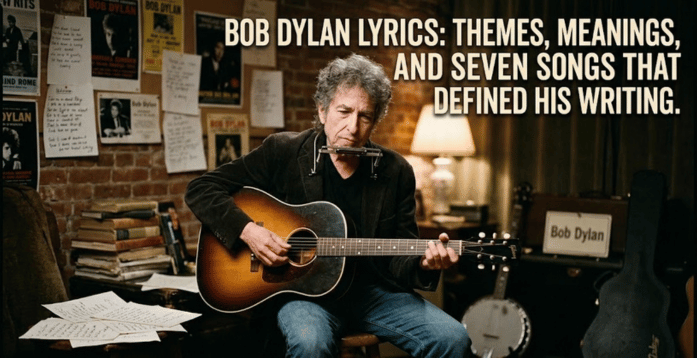
Bob Dylan lyrics changed what popular songwriting could accomplish. His songs combine storytelling, social observation, symbolism, humor, faith, and personal conflict. They also invite listeners to find meanings that can shift over time.
Dylan received the 2016 Nobel Prize in Literature for creating new poetic expressions within the American song tradition. That recognition reflects the literary weight attached to his songwriting. His work can be read closely without separating the words from their musical setting.
Quick answer: Dylan’s writing often explores freedom, injustice, love, identity, faith, memory, and social change. His songs rarely rely on a single fixed interpretation. Readers often understand them best by considering imagery, narrative voice, historical context, and the different versions Dylan performed.
Bob Dylan at a Glance
| Topic | Key detail |
|---|---|
| Primary craft | Singer-songwriter and writer |
| Major traditions | Folk, blues, rock, country, American popular song |
| Common lyrical themes | Freedom, love, loss, justice, faith, identity, memory |
| Nobel recognition | Nobel Prize in Literature, 2016 |
| Useful starting songs | “Blowin’ in the Wind,” “Like a Rolling Stone,” “Tangled Up in Blue” |
| Authorized lyric source | Official Bob Dylan website |
| Best reading approach | Consider words, music, context, voice, and changing performances |
Why Dylan’s Words Still Reward Close Reading
Dylan often writes with enough clarity to establish a theme without explaining every image. That balance gives listeners space to participate in the song. A character, road, storm, stranger, or religious image may carry several possible associations.
His published words can also differ from versions heard on recordings or later performances. The official publication, The Lyrics, includes revisions and variant forms across his career. That makes variation part of the reading experience rather than a simple error. Readers who enjoy this kind of close reading can browse the Milsblog Entertainment section for more music and pop-culture coverage.
This flexibility separates his catalog from songs built around one fixed storyline. A listener may return years later and hear a different emotional center. Age, historical knowledge, and personal experience can all change how you interpret it.
Seven Essential Songs and What Their Writing Reveals
1. “Blowin’ in the Wind”: Questions Without Easy Answers
“Blowin’ in the Wind” appeared on The Freewheelin’ Bob Dylan in 1963. Its structure relies on repeated questions concerning freedom, war, suffering, and human responsibility. The official site identifies the song as a Dylan composition from his early career.
The song does not present a conventional argument with evidence and a conclusion. Instead, the questions make moral avoidance part of the subject. The listener must consider why obvious suffering can remain unanswered.
That approach helped make the song useful beyond one historical moment. Its language allows it to adapt to changing political and social circumstances. The method matters as much as any single interpretation.
2. “Like a Rolling Stone”: Identity After Status Disappears
“Like a Rolling Stone” appeared on Highway 61 Revisited in 1965. The song follows a central figure whose social confidence and security have collapsed. Dylan repeatedly confronts that character with the consequences of sudden isolation.
The writing mixes accusation with something closer to liberation. Losing status can be frightening, but it can also remove illusions. That tension prevents the song from becoming a simple tale about punishment.
The perspective also remains unstable throughout the song. The narrator sounds judgmental, fascinated, and strangely close to the person being addressed. That emotional uncertainty keeps the character from becoming a flat symbol.
3. “Tangled Up in Blue”: Memory Told Out of Order
“Tangled Up in Blue” was released on Blood on the Tracks. Its narrative moves through relationships, places, work, separation, and reunion. The official song page also documents its long performance history.
The song feels like memory rather than a tidy chronological report. Events appear connected through emotion instead of strict sequence. People change, locations change, and the narrator keeps revisiting what happened.
That structure fits the subject of a relationship remembered across time. Memory rarely arrives in perfect order. Dylan turns that ordinary psychological experience into the song’s form.
4. “The Times They Are A-Changin’”: Change as a Force
The title track of The Times They Are A-Changin’ was released on the 1964 album. The record also included songs concerning poverty, racism, war, relationships, and social conflict. Its track list shows how strongly public issues shaped that period.
The title song treats change as something larger than one speaker or group. Different generations face pressure to recognize movements already underway. That framing gives the song both urgency and distance.
It is often described as a protest song, but its perspective is broader. The speaker observes a changing social order and warns against resisting its momentum. That distinction helps explain its continuing relevance.
5. “Every Grain of Sand”: Faith, Doubt, and Self-Examination
“Every Grain of Sand” appeared on Shot of Love and dates from 1981. The official page places the song in a period strongly shaped by spiritual themes. It continued appearing in live performances decades later.
The writing combines religious imagery with personal uncertainty. Faith does not remove struggle from the speaker’s life. Instead, belief exists beside temptation, regret, loneliness, and moral examination.
That complexity makes the song useful for readers studying Dylan’s religious writing. The speaker searches rather than delivering a simple sermon. Spiritual language becomes a way to examine responsibility and human weakness.
6. “Only a Pawn in Their Game”: Systems Behind Individual Violence
“Only a Pawn in Their Game” appeared on The Times They Are A-Changin’. The song addresses the murder of civil rights leader Medgar Evers. It shifts attention from one perpetrator toward the larger structures encouraging racist violence.
That approach does not erase individual responsibility. Instead, the song asks how political and social systems manufacture hatred. Economic insecurity and racial hierarchy become connected parts of the argument.
The method remains striking because it examines incentives behind violence. Dylan treats the event as both a crime and a symptom. That wider frame gives the song historical and analytical weight.
7. “With God on Our Side”: Patriotism Under Examination
“With God on Our Side” also comes from the 1964 album. The song examines war, national storytelling, and claims of divine approval. Its final sections turn those questions toward modern destructive power.
The writing works by repeating an idea until its certainty begins to break down. Familiar patriotic assumptions become less stable as the song continues. The narrator gradually moves from received history toward personal doubt.
This structure shows a frequent Dylan technique. He lets a speaker discover contradictions rather than announcing every conclusion immediately. The reader follows that change in consciousness.
How to Read Bob Dylan Lyrics More Closely
Start by identifying who seems to be speaking. The narrator should not automatically be treated as the songwriter himself. Dylan often uses characters, dramatic voices, and shifting points of view.
Next, look for images that repeat across the song. Roads, weather, strangers, trains, rivers, religious figures, and journeys often carry emotional meaning. Their importance usually comes from how they relate to the surrounding story.
Historical context can clarify references without settling every question. Songs about racial injustice or war benefit from knowing the events behind them. Personal songs may depend more heavily on narrative structure and emotional perspective.
The music matters as well. Rhythm, vocal delivery, pauses, and arrangement can change how words feel. A line that seems severe on paper may sound playful, uncertain, or exhausted in performance.
Recurring Themes Across the Songbook
Love and separation appear throughout Dylan’s work, but rarely in one emotional form. Relationships can involve affection, bitterness, distance, memory, desire, guilt, or resignation. That variety prevents the catalog from reducing love to simple romance.
Travel is another recurring pattern. Roads and movement can suggest freedom, exile, escape, or instability. Characters often seem to leave something behind while remaining unsure of their destination.
Social authority also receives persistent scrutiny. Politicians, journalists, institutions, wealthy figures, and moral authorities can appear as targets or symbols. Yet the songs often leave enough ambiguity for listeners to question every speaker.
Faith becomes especially prominent in parts of his later twentieth-century work. Biblical language can express belief, judgment, doubt, or personal searching. The changing emphasis makes religious imagery important across several phases.
Researchers have also identified lost love, movement, uncertainty, satire, faith, and social subjects across hundreds of compositions. That range challenges the idea that Dylan belongs to one narrow category.
Why the Lyrics Can Change Between Versions
Dylan has repeatedly revised songs during performances and publication. The official Lyrics collection specifically notes edits to numerous works. As a result, some printed versions differ from familiar recordings.
These changes can shift emphasis without changing the song’s core identity. A new word, verse order, or delivery can shift a listener’s interpretation. Live performance becomes another stage of composition.
Readers should therefore avoid treating one transcription as the only possible text. Checking the official song archive helps establish an authorized reference. Comparing recordings can then reveal how the writing developed.
Where to Read Complete Authorized Lyrics
The official Dylan website maintains a searchable songs section with individual pages. Those pages include complete authorized texts, album appearances, and performance information for many songs. That source is preferable when you need the complete wording.
Milsblog can add value by explaining themes rather than duplicating copyrighted material.
The site also covers later-generation musicians. Its Lil Yachty profile examines his music career and changing artistic direction.
Readers interested in artists working across music and film can explore its Jared Leto profile. That page includes his work as a musician alongside his acting career.
Why His Songwriting Became Literary History
The Swedish Academy awarded Dylan the 2016 Nobel Prize in Literature. Its citation recognized new poetic expressions within the American song tradition. The award placed songwriting directly inside a major international literary conversation.
That recognition does not mean every song needs academic decoding. Much of the writing works because ordinary listeners can feel its movement immediately. Literary complexity and direct musical communication exist together.
His strongest songs also tolerate disagreement. Two readers can identify different meanings while using evidence from the same work. That openness is one reason the catalog continues generating interpretation.
FAQ About Bob Dylan Lyrics
Where can I read Bob Dylan lyrics online?
The official Dylan website is the clearest authorized online starting point. Its song archive provides individual pages for a large catalog. Readers can search titles and explore album or performance information.
What are the main themes in his songs?
Common themes include love, freedom, injustice, identity, travel, faith, memory, and social change. Different periods emphasize different concerns. No single theme explains the entire catalog.
Why are some songs difficult to interpret?
Dylan often uses symbolic imagery, changing narrators, surreal scenes, and incomplete stories. Those techniques leave space between literal events and possible meanings. Ambiguity is often a deliberate feature rather than a problem.
Did Dylan win the Nobel Prize because of his songwriting?
Yes. He received the 2016 Nobel Prize in Literature for his contribution to poetic expression within American song tradition. The official Nobel record identifies him as that year’s literature laureate.
Do printed words always match the recordings?
Not necessarily. Official publications document revisions and variant texts across his career. Live performances can also change wording, emphasis, and structure.
A Better Way to Explore the Songs
Choose one song and read its official text while listening to the recording. Then identify the narrator, repeated images, historical setting, and emotional conflict. Repeat the process with another version when one is available.
Avoid searching for a single hidden answer behind every image. Dylan’s writing often becomes stronger when several readings remain possible. Context can narrow interpretations without eliminating ambiguity.
Most importantly, treat the songs as songs, not poems accidentally set to music. Words, melody, voice, rhythm, and performance work together. That combination explains much of their lasting power.
